Frank DuNN: Conversations at the junction of faith and politics
Dying in Darkness: Lies, Greed, and Ignorance
Frank Dunn
2/9/20267 min read
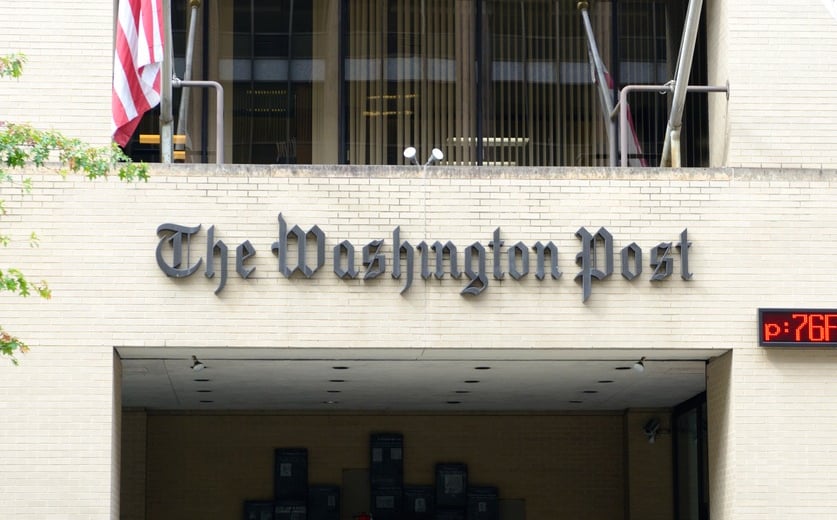
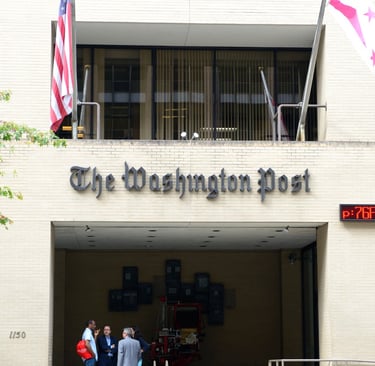
When I moved to Washington, DC, in 2004, one of the first decisions I made was to forfeit my daily reading of The New York Times in favor of subscribing to The Washington Post. Although I had long admired The Post, I had rarely purchased a copy of it. Two of my first friends in Washington were Bill MacKaye, a former Post religion editor, and Australian Kim Klein, both retired from the paper and both integral parishioners of St. Stephen and the Incarnation, the parish I’d come to serve.
During the years that followed, I became irritated at what seemed to me to be an editorial bias against the Obama Presidency. I own that I might have been wrong about that, but nonetheless I gradually stopped reading the Post and switched my allegiance back to The New York Times.
Along came the pandemic and I reconnected with the Post because of the outstanding job they were doing reporting on the pandemic. As the age of digital journalism settled in, I found myself once more reading and appreciating the Post. For half a decade, the Post and The NYT were equally my daily grounding in the news.
That ended when the election of 2024 came around and Jeff Bezos refused to allow the editorial board of the Post to make an endorsement of Kamala Harris because he wanted to curry favor with Donald Trump. I was one of the thousands of subscribers who canceled. Although I’ve never canceled my subscription to the digital NYT, I distrust it increasingly. Why? They refuse to report the actions of the Trump administration for what they are, treating them instead as serious policies, and either refusing to cover, or burying as insignificant articles, such as reporting on last October’s No Kings Day, one of the largest political demonstrations in US history, as if it were minor news. The transparent sucking-up to the Trump administration is too obvious to debate.
This morning, we’re hearing and reading the news that the once flagship Washington Post, one of the leading journalistic outlets in the entire world, is now reduced to a husk of what it once was. Most folks, I suppose, view this, if they care to categorize it at all, as a business decision (which it is), or as another casualty in the world of automation-become-AI (which it is). I, however, view it as a marker of the massive collapse of truth-telling brought about by the trifecta of falsehood, greed, and ignorance. That triad is, as far as I’m concerned, the distillation of evil.
Argue with me. Tell me that falsehood is pervasive; that there’s no avoiding it; that we are all complicit. Argue with me. Tell me, in the words of Gordon Gekko, the character played by Michael Douglas in Wall Street (1987) for which Douglas won the Oscar for best actor, “Greed is good.” It is the dynamic that empowers capitalism, which is the lifeblood of the planet, etc., etc. Argue with me. Tell me that Jeff Bezos, like Elon Musk, Mark Zuckerberg, Bill Gates, and other billionaires are quite intelligent men whom I shouldn’t insult by smearing them as ignorant.
I get it.
But I get something else too.
This trifecta of which I speak comes right out of the heart of New Testament understanding of the key problem with “the way of the world.” When John’s gospel has Jesus saying, “Be of good cheer, for I have overcome the world,” what is he talking about? He is talking not about what you and I would call “the cosmos,” but about what we might mean when we talk about “the corrupt systems of the world.” They are the systems referred to in the Liturgy for Holy Baptism[1] which some of us renew with regularity answering the question, “Do you renounce the evil powers of this world that corrupt and destroy the creatures of God?” The way that is worded reminds us both that there are systems in this world that are not evil and that those which are evil do indeed corrupt and destroy.
The slush of lies and falsehoods is so obvious that you’d think it hardly needs explanation. But the insidious thing about falsehoods is that those who fall for them, sometimes quite innocently and unintentionally, tend to latch on to what they’re told and keep believing it without question. I can’t tell you the number of things I learned in school as fact that I believed for a long time until I had enough dependable information from trustworthy sources to contradict and counteract those falsehoods and half-truths. And it’s even harder if the source who first issued the falsehood was a trusted source.
Here’s an example. I was distinctly taught in elementary school that the United States had never fought a war for territory. We’d always fought for freedom and against tyranny, the teacher said. I hadn’t gotten out of high school before I realized how big a lie that was. The Mexican War was a glaring example of a war fought over land. And if you’ve watched Ken Burns’ documentary The American Revolution, you realize how much the American revolution itself was a conflict about land, the ownership of land, the prerogative to claim land, and so forth. Another lie, still extant in the South where I grew up was “the slaves” were quite happy.” No kidding.
Money=Power. It always has and it always will. Yet we have a vibrant history in this country of charitable giving, albeit some of that giving is not altruistic. Never mind. What we don’t have, in my estimation, is a culture in which we call out greed. A huge segment of our population is enchanted by those who are high earners. That’s fine. What’s not so fine is the inability of a great many people to recognize that society is impoverished when money is always flowing upward to enrich the already wealthy. Do you remember “Occupy Wall Street”? Seems like ancient history now. Why did it disappear? I’m no expert, and there are, I’m sure, many reasons, one being short attention spans. But one reason it sank is that a great many “liberal” people didn’t want to be targeted as “socialists” or “communists.” What was the hue and cry of establishment types? “This is class warfare!” Well, yes, it was. But so is the ongoing, stealthier class warfare waged in corporate board rooms, in the stock market, in real estate deals, in big business, and above all in the lobbying industry. How about exercising some muscle and louder volume when it comes to challenging income inequality and calling into question the private amassing of billions of dollars while the poor get poorer? Is standing up for the poor not sanctioned by all the venerable spiritual traditions on the planet?
If we are looking for an occasion to practice saying something about greed, I submit the stripping down of a major voice of democracy, The Washington Post, is such a time.
Ignorance. I have debated in my own mind the question: is the crippling of the Post about ignorance or folly? It’s both. They are different, but they are great friends, ignorance and folly. Folly may be the worse of the two. But ignorance is a powerful force in American life. It comes in many forms and on many levels. When we have a President who obviously has not even read, or certainly doesn’t understand, The Declaration of Independence,[2] it is arguable that the long span of American anti-intellectualism has indeed triumphed, and not for the first time. In his venerable study of the subject, historian Richard Hofstadter linked the deeply embedded hostility to intellectualism to what he called “the paranoid style in American politics.”[3]
I continue to believe that, as important as is our focusing on resisting the enormities being committed by our government, atrocities subsidized by our tax dollars, it is equally important that we invest time, energy, and imagination focused on what kind of community we want this nation to be. We must say that in plain language, finding ways to articulate and proclaim priorities that can be readily and widely understood—and supported. Nothing, in my estimation, is more important than revisioning our educational system. If any good is to come out of the wreckage of the Trump administration, it might be that we may have a crack at rebuilding and reshaping the Department of Education in ways that will serve the several States in ushering people out of the deep suspicion of expertise and learning. It will take something different from elitist models to do that, and I’m ill equipped to say how that would ever come about. I only know that some deep systemic changes need to be made. And systemic changes are never made with a quick fix. From the beginning, public education was seen as integral to the practice of democracy. The need for renewed education is only intensified now.
The once proud Washington Post had for a time as its motto, “Democracy Dies in Darkness.” And if the light of liberty is dark, how great is that darkness.
[1] The Book of Common Prayer 1979, page 302.
[2] In an April 29, 2025, ABC News interview with Terry Moran in the Oval Office, President Trump struggled to explain the significance of the Declaration of Independence, describing it as a "declaration of unity and love and respect.” The response was widely criticized as misinterpreting the document, which actually signaled separation from England. Information accessed and confirmed February 7, 2026, at https://www.rev.com/transcripts/trump-oval-office-interview#:~:text=You%20have%20Lincoln%2C%20you%20have,Terry%20Moran%20(03:40):
[3] Richard Hofstadter, Anti-intellectualism in American Life (Vintage Press, 1966).
Dan Pure Responds
I think you put your finger on all the salient issues concerning the demise of the Post and newspapers in general.
I saw the demise of the newspaper genre begin long before the digital age in which we are submerged. I think television had a lot to do with initiating the downward spiral. Before 1945 and the end of the Second World War, radio and newspapers were the principal means by which people got their daily news. I remember when many homes had newspapers delivered and the many phone calls soliciting delivery probably began when the decline was first being felt. My hunch is as the newspapers dwindled in subscriptions and street sales, the best talent most drawn to journalism and reporting the news began a slow exit to other venues. With the advent of the internet, the retreat gathered steam.
Why don't the news media like the Post call out the flagrant lies and propaganda of the current administration? The reasons are many and varied, but I would contend that the brightest and the best no longer work at the Post or any of other major newspapers. The few bright lights that remain do not have the power to counter the knuckle dragging tactics of the Bezos of the world. What we have is a state of bland mediocrity that I fear will only get worse, my friend, and it's very clear that the Bezos of the world are quite content with mediocrity so long as their avarice and greed is sated.