Frank DuNN: Conversations at the junction of faith and politics
June 12
June 12 reminds me to love my neighbor as myself, to forgive my enemies, and to resist evil in whatever form it takes,
David Eberly
6/8/20263 min read
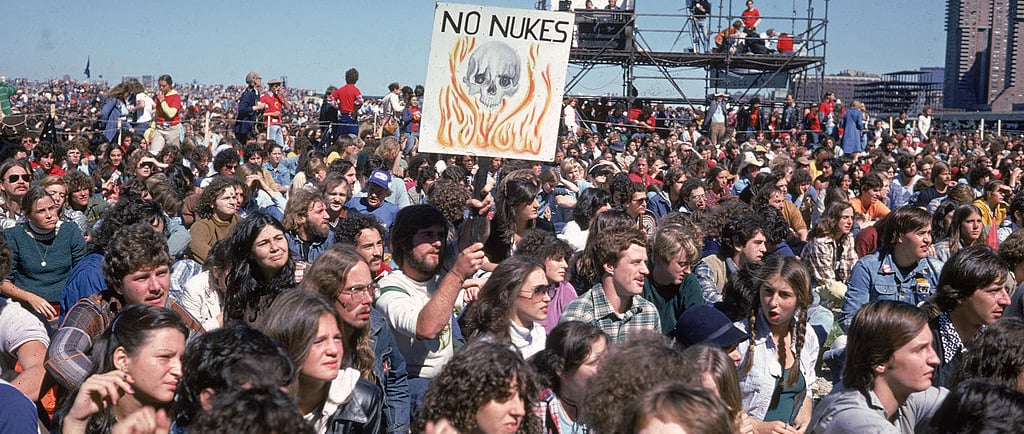
Forty-four years ago, on June 12, 1982, over a million people marched from the United Nations Plaza to Central Park to protest nuclear weapons and demand disarmament in what has been described as the world’s largest peace rally. The images of humanity overwhelming the streets and avenues of New York City still inspire awe. The march led Ronald Reagan to propose the abolition of nuclear weapons to Mikhail Gorbachev in 1986, and to a drastic reduction of nuclear missiles.
Since then, North Korea developed a nuclear bomb in 2006 and the intercontinental missiles to hit the continental United States in 2018. In 2019, Donald Trump and Vladimir Putin withdrew from the long-violated Intermediate Range Nuclear Force Treaty, making the use of tactical nukes more probable in Ukraine. Currently, the United States is at war with Iran, ostensibly to prevent it from acquiring its own nuclear weapons. With their reliance on drones, both wars have changed the nature of warfare. Instead of intercontinental missiles rising from their silos as they did in The Day After, the 1983 film which glued Americans to their TV sets, we can imagine a world swarming with drones like bats, dropping AI-designed bombs wherever they are directed by their invisible masters. “The sleep of reason produces monsters,” as Goya titled his etching.
“It is legitimate to hold that catastrophic events, once they become possible, are bound to occur,” the philosopher Jean-Pierre Dupuy states in The War That Must Not Occur. That it hasn’t, he argues, is not because of our leaders’ fear of mutually assured destruction but “chance and purely chance.” Examining a world that has gone “metaphysically MAD,” Dupuy comes to the conclusion that while a nuclear war is bound to occur, “Theoretically, then, it is possible to regard nuclear deterrence as being both effective and rational. But this cannot hide the fact that, morally, it is an abomination.”
Lately, I have been thinking about the problem of evil. We live in a violent and increasingly superstitious and ignorant world not much different than Goya’s. Evil surrounds us. June 12 is also the anniversary of the Pulse Nightclub shooting in 2016, when a gunman shot and killed forty-nine people in a LGBTQ+ night club in Orlando, Florida. Lone wolf, heads of state. Has God turned his face away from us, as we would like to believe, or have we sinned, by turning away from God and making gods of ourselves? “It is through sin,” the Mennonite Church believes, that “the powers of domination, division, destruction, and death have been unleashed in humanity and in all creation” (Confession of Faith in a Mennonite Perspective, Article 7).
A humbling little word, sin “is not an illusion . . . It involves personal responsibility and has real consequences.” Yes, I would like to think this world is all God’s fault, as if He allowed the first atom bomb to be dropped by Americans, or a domestic terrorist to murder dozens of people dancing in a bar. I would like to proclaim that God does not exist. Where may I find the hope of nuclear deterrence, of safety, of peace? In my acceptance of sin, the first step out of Dupuy’s moral abomination.
I have been a lifelong pacifist. I do not believe in the theological concept of a just war debated by Pope Leo and Donald Trump after an American missile “mistakenly” killed 168 schoolgirls in Minab. While I will not declare myself Christian, I can turn to the Mennonite faith of my forebears, who following Jesus, participate in his ministry of peace and justice, and do not kill (Article 22). Like them, I do not prepare for war or engage in it. June 12 reminds me to love my neighbor as myself, to forgive my enemies, and to resist evil in whatever form it takes, “in the spirit of gentleness:” For today, I am secure in the knowledge that I have stopped playing games and taken a step to disarm.
David Eberly is a consultant to non-profit organizations and a writer who lives in Boston.