Frank DuNN: Conversations at the junction of faith and politics
The Great Divorce Proposal
Talk about disunion or secession poses serious spiritual issues apart from a plethora of political and practical ones.
Frank Dunn
9/4/202613 min read


About a year ago, I had a conversation with a friend about politics. We both live in California. He said he believed that the best route for California was to secede from the Union. At least, thought he, the State ought to pass a provision allowing secession “should it come to that.”
At first, I thought he was kidding. He wasn’t.
Knowing him to be a person of intelligence and good will, I didn’t easily conclude that he was simply wacky, but I clearly thought his idea was a fringe one. He seemed not to know or to have forgotten that the Supreme Court ruled way back in 1869 that the Union was insoluble. Secession has no legal mechanism under the United States Constitution.
I’m hearing more talk kicking around this idea. All of it so far involves Californians except those who make it into the news like former Congress member Marjorie Taylor Green who proposed on social media that the country needs to "separate by red states and blue states and shrink the federal government.” She blamed Democrats and left-leaning policies for pushing "sick and disgusting woke culture issues" and "traitorous America Last policies," stating that conservative voters are "done" trying to coexist.
Recently in a dinner conversation, friends with politics opposite those of MTG essentially argued the same thing for the obverse reason: MAGA and rightwing policies have so corrupted the nation that the only solution is for blue States to band together and pull out of the Union. The very next day the New York Times carried a guest essay by Kurt Andersen, the author of a forthcoming novel “The Breakup.” His title: “Has America Already Undergone a Soft Breakup?”
No, America has always covered up one or more things that irritate the concept and architecture of Union. Those dynamics have rarely been “soft,” unless you define “soft” as not involving outright rebellion, which of course is exactly what brought on the Civil War. When I was a lad studying the Civil War in South Carolina, the Confederacy was treated (so it seemed to me) as a separate nation at war with the United States. It was a rebellion of States seeking to redefine the country, its principles, and its Constitution. There was nothing “soft” about the Civil War. I would argue that there’s nothing especially “soft” about the determination now on the part of those who authored and are now implementing Project 2025 to redefine what the nation is, what it stands for, how it operates, and whom it includes.
I would not be making these comments were they only political notions. But I refuse to cede the issues to those who confine their interest to politics, no matter their left/right persuasion. I believe that there is no issue that is not on some level a spiritual issue. That’s my interest. Why “spiritual”? Not because the issues are innately “religious.” Obviously, most of them are not, and some are tagged “religious” that shouldn’t be.
But if we’re human, we have spirit. Spirit is what vivifies us, keeps us energized, connected, motivated, and, when we’re at our best, open, creative, and innovative. That’s the part of us capable of making a difference. I don’t mean to discount our minds that permeate and our bodies that house our spirits.
That very conviction leads me to probe the spiritual ramifications of a “divorce” between right and left, red and blue.
First, I find no spirituality appealing that is world-denying. I am uninterested in spiritual practices that lead away from community, but rather those practices—some highly individualistic and deeply personal—that support community, such as meditation, centering, balancing, being present, creating and nurturing links between people and among different types of communities. Craving a community-conscious spirituality is rooted in the way Nature functions. Not only animals but also plants, grow together, thrive together, depend on each other, and in their several ways communicate with each other.
Because history bears witness to the communal consistency of all living things, it’s instructive to look at what happens when the obverse is tried. In the second quarter of the 19th century (roughly 1825-1850), Southern States, led by John C. Calhoun, developed the doctrine of nullification. Any State, they argued, had the right to nullify federal laws it didn’t agree with. That mentality by no means died but has continued to be a favorite tool of privileged classes protecting their own interests. As a result, a culture of denial took root. Although it’s simplistic to lump a lot of problems together under the banner of “denial,” I think a persuasive case can be made that the psychology of nullification feeds on the teamwork of Denial and Self-absorption. We usually experience such things playing out on a personal level; but if enough people collectively practice nearly any action, eventually that practice becomes normalized, as indeed it did in the South.[1]
When self-protection supersedes an ethic of shared endeavor, those with privilege and power justify ever-tightening economic and political nooses around the necks of the vulnerable and powerless. This is not simply a political issue nor an economic one. It is a spiritual issue. It is a radical denial of the communal nature underlying any civilization. Those on top must necessarily depend on the support of “servant” classes. I’m not arguing that servanthood is either bad or unnecessary. I’m arguing that servants deserve a fair share of the pie. If you’re wondering what “fair” is, try this: a living wage, adequate health care, freedom from poverty and hunger, equal protection under the law, and a safety net for those incapable of sustaining themselves.
We continue to live with the results of nullification. It led to secession. Secession led to war. And although the Union “won” the Civil War, the South succeeded, by means of Jim Crow laws, vote suppression techniques, imprisonment, structured economic inequality, racial segregation, and terror (the KKK) in extending human servitude for more than a century. And through systematic police practices and economic policies, not to mention mass incarceration, that extension of human servitude continues to this day, now as official government policy.[2]
What would a “soft divorce” or a breakup of the Union do to or for this situation? It would tremendously worsen the plight of the most vulnerable. The only hope of righting the inequalities in voting rights now virtually annulled (note the word!) by the Supreme Court is that the power of those who are working to restore voting rights (on which all other rights depend) trying diligently to redress that suppression. In my view, leaving the poor and powerless to fend for themselves is an abrogation of moral responsibility.
What’s driving this notion of breakup?
There are at least three things. Only in recent memory has the term “red states, blue states” made it into the national conversation. In the era when most people got their news from the three major networks, election results were often shown in red (for Republicans) and blue (for Democrats. Hence, the shorthand gradually became treated as an entire profile. It never really was the reality, yet the public began to treat it so.
Popularized by political commentary, it took no more than a few decades for people, who have some mysterious enchantment with labels, to operate as if the political and cultural divide in America was irreconcilable. Prodded on by the culture wars of the 1980s, 1990s, and beyond, it was easy enough to see that red and blue were the home states of the majority of people on one side or the other of the issues over which the culture wars were (and are) waged.
Polling shows that while a minority of Americans actively desire a total split, a significant portion of the population expresses deep fatigue with federal gridlock and partisan hostility. The chatter about “divorce” thrives on this sense of friction.
Yet don’t forget that none of this regionalism is new. From the beginning of the country, long before we were independent, regionalism had taken root. Not a surprise, since nearly any country of considerable size has regions that divide along historical, cultural, topographical, and sometimes linguistic lines. The South was “the Solid South” long before and long after the Civil War. While Southerners were slow to awake to the fact that Democrats in the 1950’s and 1960’s were not the same as the Democrats of the mid-nineteenth century, as a result of Republican Richard Nixon’s “Southern Strategy,” in the 1970s the majority of those States of the former Confederacy almost at once turned “red.”
Does it really need to be said that not everyone in any State aligns with the political majority in that State? Not only that, but many of us can remember when some currently red states were purple, some blue states were red, and some purple states weren’t purple. States, whether geographically close or not, form ties with other States over a variety of issues. We can see this playing out in the present as attorneys-general of Democratic-controlled States join in lawsuits against the current Administration because of a shared need to protect their interests.[3]
America is already seeing through this and other developments a trend toward functional regionalism. States are increasingly forming interstate compacts to manage climate policies, health regulations, or resource allocation independently of Washington. Furthermore, migration patterns mean people are self-sorting into states that match their cultural and political preferences.[4]
But there are practicalities that bump up against the rhetoric of separation. First there is the geography problem. America is not divided by clean state lines; it is divided between urban centers and rural areas. A "blue" state like California has more conservative rural voters than several red states combined, and "red" states like Texas feature highly progressive major metropolitan areas. It’s impossible to draw a clean border.[5]
I’m amazed that those who apparently seriously think that a breakup into regions or sections is really going to address the real problems eating away at American society. In my view, the bedrock problem is, ironically, money, in what has long been accorded the status of the richest nation on earth. Do we imagine money is not going to talk quite so loudly in liberal States?
It isn’t a lack of money that’s the problem; it is the lopsided distribution of it. In spiritual terms, money is in fact the god of the United States. Maybe it is the god of the world. I think we have a very special brand of money-worship in the USA. Capitalism is held in such precious regard that anything said that smacks of the possibility of redistributing wealth will spontaneously cause an eruption of cries liked, “Socialism!” “Communism!” “Class warfare!”
The Occupy Wall Street demonstrations of a decade and a half ago did exactly that. Although millions of people were hurting financially in the United States, the apparent suggestion that Wall Street was anything other than the gold-paved street of the New Jerusalem was anathema. Unfortunately, the lack of a coherent argument, the failure to promote feasible steps towards equalizing the distribution of money, and a general absence of consistent leadership conspired with winter weather and sanitation concerns to bring down the curtain on that now almost forgotten act of defiance.
Occupy Wall Street addressed problems at what is widely perceived as the headquarters of capitalism: Wall Street, in the metropolis of New York City. But the bleak society resulting from the rape of the earth and the oppression of the people on the low end of the capitalist grid encompasses entire regions. For example, much of Appalachia is caught in a spiral of economic collapse, a raging opioid epidemic now dominated by fentanyl, unsustainable debt, dilapidated educational structures, inadequate social resources, and the breakdown of family systems. Once vibrant small towns and rural areas wither, hollowed out by giant stores (e.g. Walmart), bought up by agricultural conglomerates (e.g., Archer Daniel Midlands and Monsanto now owned by Bayer), mesmerized by entertainment conglomerates that have assumed the place of news outlets (Meta, X), and a health industry run by big pharmaceutical companies who often have government by the tail.
Democratic States like California are by no means free of their own pockets of economic collapse. Nor are the so-called “blue islands” of urban centers free of their own brand of decrepitude. The cost of living is now so high in San Francisco and the Bay Area in general that hundreds of homeless persons pack the streets, doubtless to the disgust of the well-housed, well-fed, and employed. Massachusetts’ historic mill towns and cities struggle to recover from decaying manufacturing. Illinois mirrors those conditions in its Metro-East and Downstate sections encompassing cities like East St. Louis and Decatur. Washington’s timber and fishing villages struggle to reverse economic stagnation. In each of these cases, not far away from the decaying structures of the Past live the tycoons, the entrepreneurs, the high-tech teams. Will shedding ourselves of the burden of mostly poorer States help the neediest in relatively rich ones?
At this point, it would be superfluous to say that these conditions pose serious spiritual questions and challenges. My argument is that nothing whatsoever is solved by disengaging from the very battles whose outcomes depend on healthy pushback on the systems that are oppressing and corrupting, draining and stifling the children of Earth.
Back to the Center, if you will. The Center is always tied to the question it insistently asks: how shall we be whole?
I know it’s dicey to extrapolate from personal experience to societal realities. Yet, there is an instructive parallel between claiming all the parts of oneself, especially the neglected and repressed pieces, the threatening and scary parts, and claiming all the onerous difficulties in this country in which we are embedded.
I know what it is to engage in internal “nullification,” trying to banish parts of me that don’t fit my conscious identity. As I look at yours and my role as citizens, the question becomes: how do I—how do we—recognize the difference between opting out of a larger collective as an act of self-preservation and bailing out as a retreat into fragmentation?
Self-sorting into regional or digital echo chambers promises comfort—or at least a reprieve from incessant chaos, but true wholeness requires engaging with difference. If we say, as I do, that my aim is to be a whole person claiming every part of myself, encouraging others to become whole persons claiming every part of themselves, what do we gain by turning aside from the differences that genuinely threaten us rather than engaging with them on some level?
Wholeness is neither capitulation to naïveté nor dodging differences. Sometimes integrity requires friction. How do we discern the difference between constructive, principled boundary-setting and mere reactivity or tribal division?
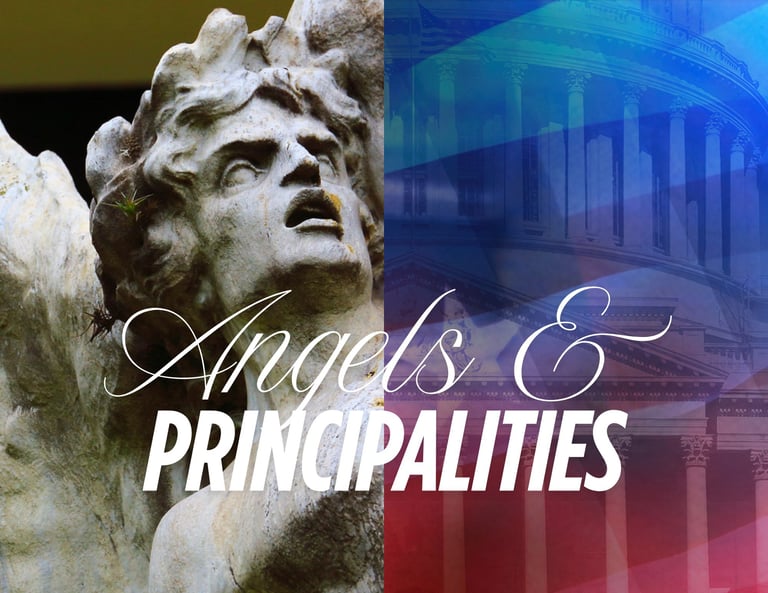
When we pose the issue that way, we share common ground with that long line of prophets and sages, theologians and other thinkers, who have articulated this problem as a struggle against “powers and principalities.” To echo the words of the Apostle Paul in the Epistle to the Ephesians [6:12]: “We are not wrestling in a physical fight against other people, but we are in an unseen spiritual war against the rulers of the darkness of this world, against spiritual wickedness in high places.”[6] Paul’s “powers and principalities” equate with the corporate monopolies and regional tribalism at this moment. They are animating supra-individual structures that demand human sacrifice and allegiance. And that is precisely what I have vowed to renounce in my Baptism: “the evil powers of this world that corrupt and destroy the creatures of God.”[7]
Just because I do not have pat answers to this dilemma and its attendant questions does not mean those questions are simply rhetorical. To be in the fight—or in my language, to take up the cross and identify with suffering creation—means not just some sugary platitude pretending that being nice is the answer, but identifying with the despised, downtrodden, and rejected, and going to bat for them. Indeed, we ourselves might be among those whom we are defending. In a sense, I think that our solidarity with humanity—and all creation—indicates that all caring souls are in this war in self-defense.
I continue to say, “Do what you can, not what you can’t.” I am also fond of the old slogan, “Bloom where you are planted.” And for years I had pinned on my refrigerator a now lost little piece of cloth I got at a Bread and Puppets performance, “Unfuck the World.”
You and I are embodied beings who live in physical places, yet we are constantly pulled into abstract national or global outrage. I think the way out and the way up is most likely reconnecting with our local geography, with our neighbors, being involved in tangible civic life.
If we are going to stay in a union, then let us work to make it a communion, in which persons value persons as worthy of a life that is healthy, whole, and free.
My own center is fed by the stream I call True Resurrection. That’s never about a remote future life in a problem-free heaven. It is about living in confidence that, in the words of Julian of Norwich, “All shall be well and all shall be well, and all manner of thing shall be well.”[8] It should be clear to us that there will be no day on earth when the banner of victory will be waved declaring the battle won once and for all. Certainly, it won’t be if flawed human beings are in the struggle.
If eternal vigilance is the price of liberty,[9] so renewed determination and strengthened zeal are liberty’s rewards.
[1] Read The Mind of the South, a book written by W.J. Cash, a South Carolinian journalist, in 1941 [New York: Random House, Vintage Books, 1991]. Although the book's argument is not about the alliance of denial and self-absorption, the author examines how Southerners typically hold two contrary values simultaneously. I would argue that denial and self-absorption, while not contrary, are similarly tied together in a co-dependence whereby persons practice self-absorption while denying that they are doing so. This condition is by no means restricted to Southerners!
[2] See Michelle Alexander, The New Jim Crow: Mass Incarceration in the Age of Colorblindness. The New Press, 2012, reprinted in 2020.
[3] For example, multi-state coalitions of State Attorneys General frequently file joint litigation to preserve local environmental standards and civil rights protections (e.g., California v. EPA or State coalition filings challenging federal executive orders). See Paul Nolette, Federalism on Trial: State Attorneys General and American Politics (University Press of Kansas).
[4] See Bill Bishop, The Big Sort: Why the Clustering of Like-Minded America is Tearing Us Apart (Houghton Mifflin Harcourt, 2008), which documents how Americans have increasingly self-sorted into politically homogeneous neighborhoods and states over recent decades.
[5] See this article from “The Imaginative Conservative,” online at https://theimaginativeconservative.org/2023/03/three-reasons-national-divorce-shatter-america-john-horvat.html#:~:text=The%20second%20problem%20is%20inextricability.%20The%20simple,further%20break%2Dups%20on%20an%20increasingly%20local%20scale. Accessed September 3, 2026.
[6] Ephesians 6:12, translation and paraphrasing are mine.
[7] Holy Baptism in The Book of Common Prayer,” p. 302. This refers to one of the three renunciations of evil made by all candidates for Holy Baptism and renewed each time the Baptismal Covenant is recited.
[8] Julian of Norich, Revelations of Divine Love (Hammondsworth, Middlesex, England: Penguin Books, 1973), chapter 27, page 103. The traditional translation is above. The words on the cited page are: “All is going to be all right; all is going to be all right; everything is going to be all right.”
[9] This phrase is frequently misattributed to Thomas Jefferson. The Irish lawyer and politician John Philpot Curran spoke the foundational sentiment in a 1790 Dublin speech. He stated, "The condition upon which God hath given liberty to man is eternal vigilance.” From the internet, 3 September 2026.
The American abolitionist Wendell Phillips popularized the modern, succinct phrasing during an 1852 speech to the Massachusetts Anti-Slavery Society. He stated, "Eternal vigilance is the price of liberty; power is ever stealing from the many to the few.” From the internet, 3 September 202