Frank DuNN: Conversations at the junction of faith and politics
The Memorial Day that Was
"Memorial Day" calls for more than a day or a weekend remembering those whose blood ran till their hearts stopped in the cause of saving “the last, best hope of humankind.”
Frank Dunn
5/26/20265 min read
I never had trouble remembering Memorial Day when I was a kid. It coincided with my birthday. Back before it became a weekend it was always May 30th. And before “Armistice Day,” November 11, became “Veterans Day,” Memorial Day was for many an occasion to honor all veterans.
On May 30, 1945, my mother went to the hospital to deliver a baby. On that same day, Gus Burroughs, one of her favorite uncles, lay dying. I can’t remember the day as having called much attention to Uncle Gus’s death, but I do remember a kind of solemnity associated with veterans, especially those, like my father, who were on the day I was born overseas still fighting the last battles of World War II.
On my 25th birthday, Daddy sent me a card in which he enclosed the telegram Mama had sent him announcing the birth of a baby boy, assuring him that mother and baby were doing fine. In a lengthy note enclosed in the card, he noted that when he received the telegram he was headed towards the most frightening experience of his young life, the Battle of Okinawa. Not until three months had passed would Japan surrender unconditionally.
What I never learned in my South Carolina childhood was that Memorial Day was established to commemorate the fallen Union soldiers of the Civil War. I vaguely remember one of my elementary school teachers referring to Memorial Day as relatively unimportant for Southerners (she meant white Southerners, of course), because it was a Yankee holiday. Some other day (I can’t say I remember and really don’t want to spend the time looking it up now) was “Confederate Memorial Day.” If it ever caught on, it never caught my attention.
I haven’t transferred my birthday to “Memorial Day weekend,” but I continue to have a fondness for the latter. I’m not a veteran. I would probably do better serving in the military now than I would have when I was eligible to be drafted at age 22. I am sandwiched between two brothers who were Marines, one who spent at least a year in Korea in the 1950’s, and the other who after twenty years retired having the rank of Colonel. I respect the military and I appreciate many of the aspects of military life.
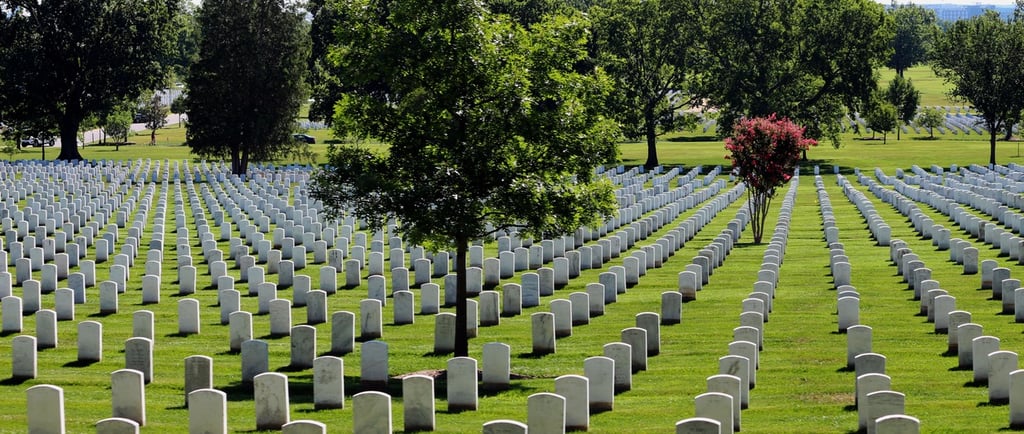
Respecting the military has never impeded my commitment to peace. Our species is not likely ever to evolve to the point where serious fights and struggles don’t break out. At the rate we are going, that possibility seems vainer than ever. But Memorial Day is not an occasion for arguing for or against an abstraction called “the military.” Rather, it is a day that belongs to the thousands who lie buried in national cemeteries and private graveyards across the land. It belongs particularly to that generation who took up arms to fight for a country that was “dedicated to the proposition that all are created equal.”
A neighbor of mine and I chatted on the street recently. “I’m ready,” he said. “I’m trained in combat. I know how to use a firearm. And I might well have to if these sons of bitches come for me or my kids or grandkids.” He went on to say how he figured a second civil war was inevitable. I listened. I wasn’t talking to a crazy man. I also knew better than to pontificate about a future I’m no position to predict.
We’re already in a “war,” if you want to call it that, I said. The question is not whether it’s a struggle or a battle or a skirmish or a war, but how we conduct it. No, I don’t mean a war about oil and the Strait of Hormuz or the price at the pumps. It’s not about Israel or Hamas or the Ayatollahs. It is the ongoing struggle about whether the USA is going to be a true democracy, ruled by law and not by persons, a democracy in which every person counts.
This is not a new contest. It is as old as the first European to set foot on North American soil. From the beginning of colonization, we have struggled over the question of who owns land, who has a right to inhabit the land, and who has political power. Money and wealth have dominated the unfolding story of the United States. They still do.
Ironies abound. Indigenous people who themselves poured into a previously unexplored territory, ultimately got pushed onto reservations conceived largely as necessary spaces to preserve the choice land first for colonizers and in general for the large white patriarchy.
For as long as I can remember, people have been talking about the moral decay of the United States. When I was a boy, the “Moral Rearmament” movement was one in a long line of efforts to address the perceived decay of Virtue.
But way before anyone reading this was born, the Puritans in 17th century Massachusetts were bothered by what the steeple-crowned elders considered apostacy. The Great Awakening of the 1720-40’s was kicked off by the eloquent and brilliant Jonathan Edwards with his sermon at Enfield, Connecticut, “Sinners in the Hands an Angry God.” Frontier revivals mushroomed.
Before the end of the 18th century, the Second Awakening dawned as people tried to put together the shards of a society stressed and thoroughly riven by the tensions of the American Revolution.
All the while, festering like a colossal boil under the skin of the Republic, enslavement of human beings lathered the monied class of Southern planters who were convinced that the notion that we’re all created equal was claptrap. What really mattered to them was that they remain in power, dictating not only the course of their own lives and the lives of the enslaved persons they “owned” and controlled, but that they steer the country in their direction. They came close to winning the battle. As Heather Cox Richardson has pointed out, in very many ways the South did in fact win the Civil War. Southern slave owners have morphed into today’s billionaire oligarchs.
And that brings us to the reason for spending more than just a day or a weekend remembering those whose blood ran till their hearts stopped in the cause of saving “the last, best hope of humankind.”
Even before the Civil War, yet another Great Awakening was spreading. This time it was sparked by the rousing of social conscience, a major dimension of which was an awakened population that began to understand the urgency of stopping the cancerous spread of slavery. The Republican party was born to save democracy. The idea embedded in the words of slave-owner Thomas Jefferson in the Declaration of Independence that the rights of life, liberty, and the pursuit of happiness are baked into life by the Creator and are thus unalienable was worth saving. More than anything, the ideals of the party of Lincoln and the eloquence of Lincoln himself drew me as a teenager to want to emulate Lincoln and identify with his party.
Oh, democracy will survive alright. It remains to be seen what will happen to it in America. But democracy is too powerful, and too obviously right an idea to be driven out of existence entirely. As long as Jews gather to celebrate the liberation narrative at Passover; as long as clusters of people defy the machinery of authoritarianism; as long as one heart is beating with passion for justice and equality, the seed of democracy will spring from the composting bodies of the dead who gave their lives that government of the people, by the people, and for the people, might not perish from the earth.
As Joyce Vance puts it in the title of her recent book, giving up is unforgivable. So is forgetting the price of giving up and the cost of holding on.
I’m willing to pay the price, come what may, cost be damned. How about you?
Leonard Lane responds
This picture [of the cemetery above] reminds me of a visit to Gettysburg at age 14.
I could sense the vibration of that horrific event.
I felt it recently looking at the bombed-out school remains in Iran.
We live in perpetual thanatos.
Our calling to show the djvine light in us is acute, our survival is speaking, perhaps for the last time.